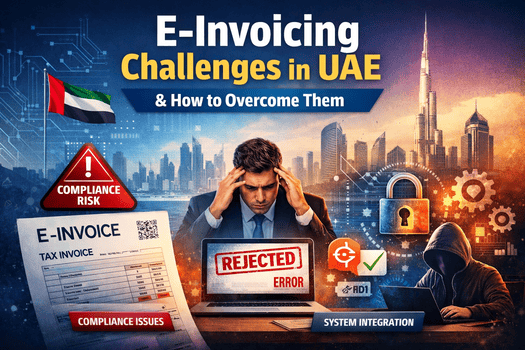
The UAE is stepping into a new phase of financial transparency. With mandatory e-invoicing rolling out from July 2026, businesses are being pushed toward a fully digital invoicing ecosystem.
On paper, it sounds like a simple upgrade—replace PDFs with structured invoices.
But in reality? It’s a complete transformation of how finance, tax, and operations work together.
Many businesses in the UAE are not struggling because they don’t understand e-invoicing.
They struggle because they underestimate the complexity behind it.
Before You Continue…
Get a free readiness assessment from Total Edge Technologies and identify gaps before compliance deadlines hit.
1. Regulatory Complexity & Constant Updates
E-invoicing in the UAE is not just about generating invoices digitally. It involves structured formats, compliance rules, and evolving frameworks.
The Problem
E-invoicing in the UAE isn’t just about generating invoices digitally. It involves:
- Structured formats (XML, PINT AE)
- Integration with government frameworks
- Compliance with VAT rules under FTA
The challenge? Regulations are still evolving, and businesses must continuously adapt to new compliance requirements.
The Reality
Many companies implement systems once and assume they’re “done.”
That’s where compliance failures begin.
The Solution
- Assign a dedicated compliance owner (internal or outsourced)
- Subscribe to FTA and Ministry of Finance updates
- Use compliance-ready ERP systems that auto-update regulations
Smart businesses treat compliance as an ongoing process, not a one-time setup.
Struggling to keep up with UAE e-invoicing regulations?
Our experts can help you stay compliant with end-to-end implementation and ongoing support.
2. ERP & System Integration Issues
The Problem
Most UAE businesses already use ERP systems like Zoho, SAP, or Tally.
But e-invoicing requires these systems to:
- Connect with Accredited Service Providers (ASPs)
- Support Peppol-based data exchange
- Handle real-time invoice validation
Legacy systems often fail here.
The Reality
Integration is where most projects get delayed—not because of technology, but because of poor planning.
The Solution
- Conduct a gap analysis of your current ERP
- Choose an ASP-compatible solution
- Work with experts for API-level integration
If your ERP cannot integrate smoothly, upgrading is not optional—it’s inevitable.
Not sure if your current ERP supports UAE e-invoicing?
We’ll audit your system and recommend the best upgrade or integration path.
3. Data Accuracy & Validation Errors
The Problem
E-invoicing demands perfect data. Even small errors can lead to rejection:
- Incorrect VAT calculations
- Missing TRN numbers
- Wrong invoice structure
In UAE systems, invoices may be rejected instantly if data is incorrect.
The Reality
Most businesses still rely on manual data entry or inconsistent processes.
The Solution
- Implement automated validation rules
- Standardize master data (customers, tax codes, items)
- Eliminate manual invoicing wherever possible
In e-invoicing, data quality = compliance.
4. Real-Time Reporting Pressure
The Problem
Unlike traditional invoicing (monthly reporting), e-invoicing requires:
- Near real-time invoice submission
- Immediate validation and approval
This shift demands faster systems and processes.
The Reality
Many businesses are not built for real-time operations—they rely on batch processing.
The Solution
- Upgrade to cloud-based ERP systems
- Automate invoice generation workflows
- Ensure high system uptime and internet reliability
Delays in reporting can directly impact compliance and cash flow.
5. Data Security & Cyber Risks
The Problem
E-invoicing involves transmitting sensitive financial data digitally.
This increases risks like:
- Data breaches
- Invoice tampering
- Unauthorized access
Cybersecurity becomes a major concern.
The Reality
Many SMEs overlook security while focusing only on compliance.
The Solution
- Use systems with end-to-end encryption
- Implement role-based access control
- Conduct regular security audits
Compliance without security is a ticking time bomb.
6. Employee Readiness & Change Resistance
The Problem
Technology is only half the battle. The real issue is people:
- Finance teams not trained on new workflows
- Resistance to change
- Errors due to lack of understanding
The Reality
Even the best systems fail if users don’t adopt them properly.
The Solution
- Conduct hands-on training sessions
- Build simple SOPs for invoicing workflows
- Assign internal champions for adoption
Digital transformation fails when teams are left behind.
7. Cost of Implementation
The Problem
E-invoicing is not free. Costs include:
- Software upgrades
- ASP integration
- Training & consulting
For SMEs, this feels like a heavy investment.
The Reality
Many businesses delay implementation due to cost concerns—only to face penalties later.
The Solution
- Start with a phased implementation approach
- Choose scalable cloud solutions
- Focus on ROI (automation, fewer errors, faster payments)
The cost of non-compliance is always higher than implementation.
Worried about implementation costs?
Total Edge offers cost-effective e-invoicing solutions for SMEs and enterprises with clear ROI.
8. Supplier & Customer Readiness
The Problem
E-invoicing doesn’t work in isolation. It requires:
- Suppliers to send compliant invoices
- Customers to accept structured formats
If your ecosystem isn’t ready, operations break.
The Reality
Many businesses overlook this dependency.
The Solution
- Educate vendors and partners early
- Standardize invoice formats across the supply chain
- Choose widely accepted frameworks (like Peppol)
E-invoicing is not just a system—it’s a network.
Final Thoughts
Most businesses think e-invoicing is a software problem.
It’s not.
It’s a business transformation challenge involving:
- Compliance
- Technology
- People
- Processes
The companies that succeed in UAE’s e-invoicing transition will not be the ones who “implement software”—
They will be the ones who prepare strategically, early, and holistically.
Ready to implement UAE e-invoicing the right way?
Total Edge Technologies helps businesses with:
✔ ERP integration
✔ Compliance setup
✔ End-to-end e-invoicing implementation
✔ Ongoing support & optimization
FAQs
1. When will e-invoicing become mandatory in UAE?
E-invoicing is expected to be mandatory from July 2026, starting with B2B and B2G transactions.
2. What are the biggest challenges in UAE e-invoicing?
Key challenges include compliance, ERP integration, data accuracy, real-time reporting, and employee readiness.
3. Why are invoices rejected in e-invoicing systems?
Invoices are often rejected due to incorrect VAT data, missing fields, or format errors.
4. Do small businesses need to adopt e-invoicing?
Yes, UAE e-invoicing will apply to most businesses, making compliance essential regardless of size.
5. How can businesses prepare for UAE e-invoicing?
By upgrading ERP systems, ensuring data accuracy, training staff, and working with compliant service providers.