
Introduction
Across the UAE, businesses are rapidly moving toward digital transformation to remain competitive in an increasingly data-driven economy. From manufacturing companies in Dubai Industrial City to retail chains in Abu Dhabi and logistics firms operating across free zones, organisations are recognising that disconnected systems slow growth, increase operational risk, and limit decision-making accuracy.
Enterprise Resource Planning (ERP) systems have emerged as the backbone of modern business operations. When implemented correctly, an ERP platform connects finance, procurement, inventory, HR, sales, and operations into one unified ecosystem. However, ERP implementation is not simply a software installation — it is a strategic business transformation.
Many UAE organisations invest heavily in ERP systems yet fail to achieve expected results due to poor planning, unrealistic timelines, or a lack of internal alignment. A successful implementation requires structured execution, leadership commitment, and a clear understanding of regional compliance requirements such as VAT regulations and reporting standards.
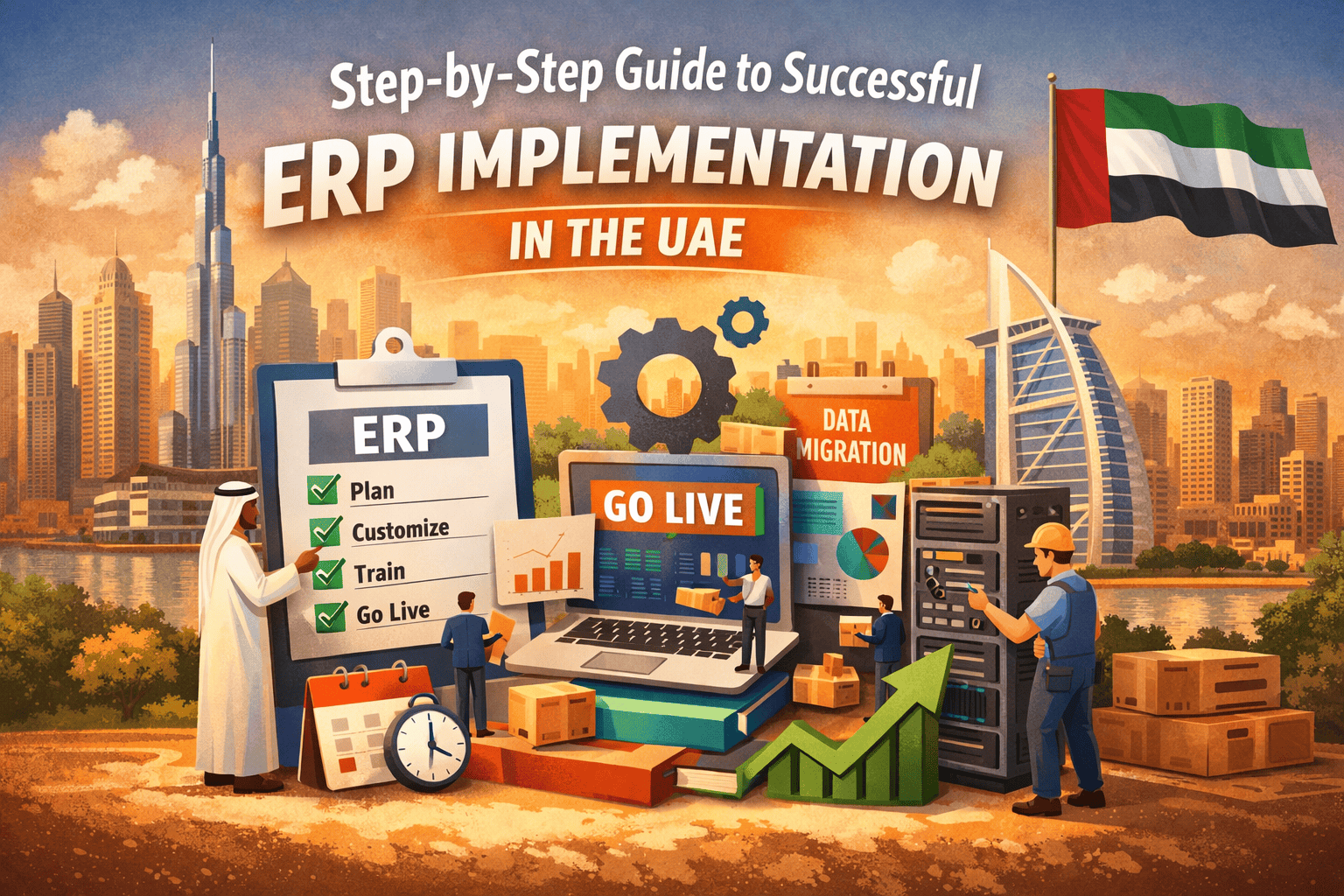
This guide explains a practical, step-by-step approach to ERP implementation in the UAE, along with proven tips and the most common mistakes businesses should avoid.
Understanding ERP Implementation in the UAE Context
ERP adoption in the UAE comes with unique considerations. Companies operate within diverse regulatory environments, multilingual workforces, and fast-moving markets. Businesses must ensure their ERP system supports:
UAE VAT compliance and financial reporting
Multi-currency transactions
Free zone and mainland operational structures
Arabic and English documentation needs
Scalability for regional expansion
Organisations that treat ERP implementation as a technology upgrade often struggle. Those who approach it as a business improvement initiative typically succeed.
What Is ERP and Why Every UAE Business Needs It in 2026?
Step 1: Define Clear Business Objectives
Every successful ERP journey begins with clarity.
Before selecting software or engaging consultants, leadership teams must answer a fundamental question:
What problems are we trying to solve?
Common UAE business challenges include:
Manual accounting processes
Inventory inaccuracies
Lack of real-time reporting
Poor coordination between departments
Compliance risks
Instead of vague goals such as “digital transformation,” define measurable outcomes like:
Reduce financial closing time by 40%
Improve inventory visibility across warehouses
Automate procurement approvals
Strengthen audit readiness
Practical Tip
Create an internal steering committee involving finance, operations, IT, and senior management. ERP decisions should never be made by IT alone.
Common Pitfall
Many companies rush into software selection without defining operational goals, leading to expensive customisation later.
Step 2: Conduct a Detailed Business Process Assessment
ERP implementation exposes inefficiencies that may have existed for years.
Document existing workflows across departments:
Finance processes
Procurement cycles
Sales operations
HR management
Supply chain activities
Identify:
Duplicate data entry
Manual approvals
Spreadsheet dependency
Reporting delays
In the UAE market, growing companies often rely on legacy tools or isolated accounting software that cannot scale with expansion.
Practical Tip
Map both current processes and ideal future workflows before implementation begins.
Common Pitfall
Attempting to replicate outdated processes inside a new ERP system instead of improving them.
Step 3: Choose the Right ERP Implementation Partner
Technology alone does not guarantee success. The implementation partner plays a decisive role.
An experienced UAE-based ERP consultant understands:
Local tax regulations
Industry requirements
Regional business practices
Integration challenges
Working with a knowledgeable partner such as Total Edge ensures alignment between software capabilities and business objectives.
What to Look For
Proven UAE implementation experience
Industry specialization
Post-implementation support
Training capability
Transparent methodology
Common Pitfall
Selecting vendors solely based on price rather than expertise.
Step 4: Select ERP Software That Matches Business Needs
Not all ERP platforms suit every organisation.
Key evaluation factors include:
Scalability
Cloud vs on-premise deployment
Integration capability
Reporting flexibility
Compliance readiness
User experience
UAE businesses expanding across GCC markets should prioritise systems capable of handling multi-entity operations.
Practical Tip
Request real business scenario demonstrations instead of generic product presentations.
Common Pitfall
Choosing overly complex systems that exceed operational requirements and increase implementation costs.
Step 5: Develop a Realistic Implementation Plan
ERP implementation requires structured project management.
A typical roadmap includes:
Requirement confirmation
System configuration
Data migration
Integration setup
Testing phases
User training
Go-live execution
Implementation timelines vary depending on company size, but unrealistic deadlines often create long-term operational issues.
Practical Tip
Adopt phased implementation where possible instead of deploying all modules simultaneously.
Common Pitfall
Underestimating the time required for testing and user adoption.
Step 6: Data Preparation and Migration
Data quality directly affects ERP performance.
Before migration:
Remove duplicate records
Standardise customer and supplier data
Verify financial balances
Clean inventory databases
Many UAE companies discover inconsistent historical data during this stage.
Practical Tip
Assign internal data owners responsible for validation.
Common Pitfall
Migrating unnecessary historical data that complicates system performance.
Step 7: System Configuration and Customisation
ERP systems should align with business processes while maintaining standard functionality.
Configuration includes:
Financial structures
Approval workflows
Reporting formats
User permissions
VAT settings
Customisation should be minimal and strategic.
Practical Tip
Adopt industry best practices embedded within ERP systems whenever possible.
Common Pitfall
Excessive customisation that increases maintenance complexity and upgrade challenges.
Step 8: Employee Training and Change Management
Human adoption determines ERP success more than technology.
Employees often resist new systems due to unfamiliar workflows.
Effective change management includes:
Early communication
Departmental training sessions
Role-based learning
Continuous support
In multicultural UAE workplaces, training should consider varying technical skill levels.
Practical Tip
Identify internal “ERP champions” who assist colleagues during transition.
Common Pitfall
Providing training only before go-live without ongoing support.
Step 9: Testing Before Go-Live
Testing ensures operational stability.
Types of testing include:
Functional testing
Integration testing
User acceptance testing
Financial validation
Simulate real business scenarios such as procurement cycles or monthly financial closing.
Practical Tip
Run parallel operations temporarily to verify accuracy.
Common Pitfall
Skipping testing phases due to deadline pressure.
Step 10: Go-Live Strategy and Execution
Go-live marks the transition from legacy systems to ERP operations.
Successful organisations:
Schedule launch during low-activity periods
Maintain dedicated support teams
Monitor system performance closely
Immediate issue resolution prevents operational disruption.
Practical Tip
Prepare contingency plans before launch.
Common Pitfall
Assuming implementation ends after go-live.
Step 11: Post-Implementation Optimisation
ERP implementation is an ongoing journey.
After deployment:
Analyse performance metrics
Gather user feedback
Optimize workflows
Introduce advanced modules
Many UAE companies unlock true ERP value months after implementation through continuous improvement.
Practical Tip
Schedule periodic system reviews with implementation partners.
Common ERP Implementation Challenges in the UAE
1. Lack of Executive Involvement
Leadership disengagement often delays decisions and reduces accountability.
2. Poor Requirement Definition
Incomplete planning leads to scope changes and budget overruns.
3. Inadequate Training
Untrained users revert to manual processes.
4. Unrealistic Expectations
ERP improves efficiency but does not instantly fix operational culture.
5. Ignoring Compliance Needs
VAT and regulatory requirements must be embedded from the start.
Practical Success Tips for UAE Businesses
Treat ERP as a business transformation project
Invest in employee engagement early
Maintain clear communication across departments
Focus on long-term scalability
Choose partners with regional expertise
Monitor measurable performance outcomes
Organisations that follow structured implementation practices typically achieve improved visibility, faster reporting, and stronger operational control.
The Long-Term Value of ERP for UAE Enterprises
A properly implemented ERP system delivers measurable advantages:
Real-time financial insights
Improved inventory management
Automated workflows
Better customer service
Enhanced compliance readiness
Data-driven decision making
As UAE industries continue embracing digital innovation aligned with national economic initiatives, ERP platforms play a critical role in sustainable growth.
Conclusion
ERP implementation represents one of the most significant operational investments a business can make. Success depends not on software selection alone but on planning, leadership commitment, and disciplined execution.
UAE organisations that approach ERP adoption strategically gain a powerful foundation for efficiency, scalability, and competitiveness. By following a structured implementation roadmap, avoiding common pitfalls, and working with experienced specialists, businesses can transform complex operations into streamlined, intelligent systems.
For companies seeking reliable ERP implementation and digital transformation expertise in the UAE, Total Edge supports organisations through every phase — from planning and deployment to optimisation and long-term success.